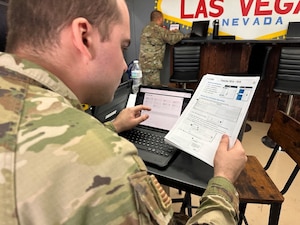
Information Aggressors attack Red Flag 14-2 Published March 11, 2014 By Airman 1st Class Jake Carter 99th Air Base Wing Public Affairs NELLIS AIR FORCE BASE, Nev. -- When Red Flag 14-2 started on Mar. 3 at Nellis AFB, information aggressors were already hard at work. During Red Flag operations, information aggressor specialists attempt to attack networks, take pictures of Airmen's restricted area badges and search through trash to try to reconstruct ripped or torn up paper that contains information related to the Red Flag missions. "The integrated cyber domain is key to providing a realistic full-spectrum opposing force training environment for our war fighters," said Quinn Carman, 57th Information Aggressor Squadron technical lead and team chief. "In any modern conflict, our forces are going to face an enemy which will use cyber both directly and indirectly to deny, degrade and disrupt. The 57th IAS is able to bring threat-representative cyber capabilities to the Red Flag Exercise as a part of a complete and integrated Aggressor Opposing Force." All of their work is relayed to the aggressor chairman during Red Flag, whose job it is to orchestrate all of the different specialties of the Adversary Tactics Group--air, air defense, space and information and cyber operations. The aggressor's are considered the enemy and they attempt to defeat the blue forces, also known as the good guys. Information aggressors try daily to find information to get an edge on their opponent. They also use the information gathered as a way to show how they did it so the blue forces can protect it during future missions during Red Flag. "We go out and find people [that] leave their badges out when they are out in public areas, [and] take pictures of them. We go up to people and start talking to them to see if they can give us any information they really shouldn't give us," said Capt. James Emge, 57 IAS flight commander. "We also do things such as key leader targeting and we look for what planes and weapons load outs are flying so we can pass that to red air so they know who to target." When attacking networks, they can also find out how the enemy talks through radio communication to help the aggressors better train blue forces about good operations security. "We can get information on what frequencies blue forces are using and then pass that to the red aggressors so they know exactly what frequencies to jam," Emge said. As technology and capabilities have progressed and is becoming an integral part of the military, the information aggressors continue to improve their tactics. "We are constantly developing new capabilities all the time to push the envelope and to better train," Emge said.